

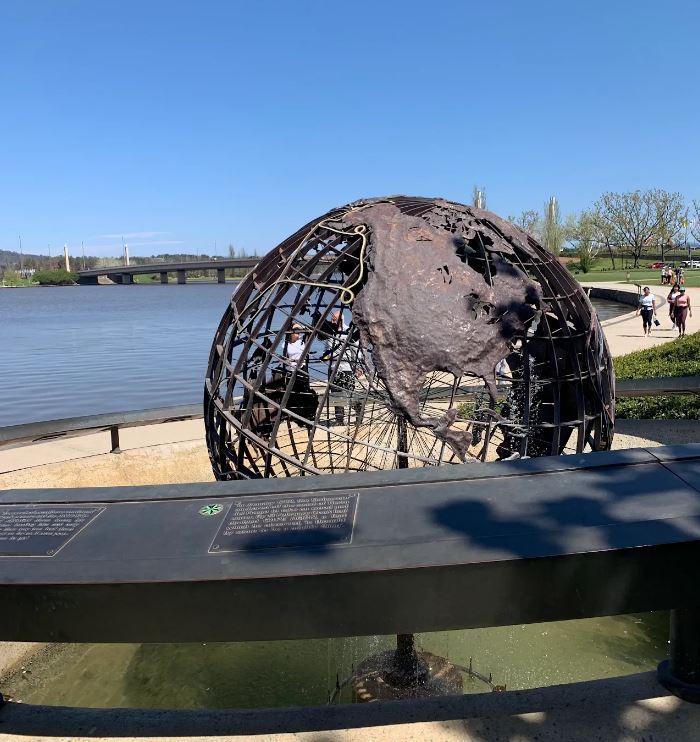
Canberra’s living monument is the Captain Cook Memorial Jet, an engineering marvel that has remarkably survived as a stunning sight and a cultural icon. The jet was designed to commemorate the bicentennial of Captain James Cook’s sighting of Australia’s east coast and was inaugurated by Queen Elizabeth II in 1970. However, it has significantly changed its identity over time, becoming a representation of modern ingenuity and civic pride.
The Central Basin of Lake Burley Griffin is dominated by a vertical performance that rises to an incredible 152 meters when both pumps are operating. It resembles a skyscraper of water. Six tonnes of water are launched into the air at 260 kilometers per hour by its incredibly effective sheer power, creating a picture that combines elegance and force. Its ability to create an almost theatrical pause in the rhythm of Canberra’s everyday life is frequently praised by visitors.
| Detail | Information |
|---|---|
| Name | Captain Cook Memorial Jet |
| Location | Central Basin, Lake Burley Griffin, Canberra, ACT, Australia |
| Inauguration | 25 April 1970 by Queen Elizabeth II |
| Purpose | Built to commemorate the Bicentenary of Captain James Cook’s first sighting of Australia’s east coast in 1770 |
| Height | Up to 152 metres at peak, 114 metres on a single pump |
| Power | Two 560 kW electric motors with four pumps, exit speed of water 260 km/h |
| Water Volume | Approximately six tonnes of water in the air at any one time |
| Operation Hours | Daily from 11 am to 2 pm (weather permitting) |
| Design Inspiration | Jet d’Eau, Geneva, Switzerland |
| Associated Feature | Captain Cook Memorial Globe, tracing Cook’s voyages in copper bas-relief |
The jet’s dual significance as a cultural icon and a technical marvel is what makes it so incredibly appealing. The design, which was modeled after Geneva’s Jet d’Eau through extensive diplomatic negotiations, demonstrates Australia’s readiness to compete with world-renowned cities. However, by placing it in the center of the capital, the memorial firmly ties itself to Australian history. The globe sculpture that goes with it charts Captain Cook’s travels, connecting contemporary Canberra to his adventures.
The 2017 renovation made sure that the jet’s physical structure and symbolic meaning remained remarkably robust. Canberra’s landmark has been transformed not only as a memorial to an explorer but also as a welcoming area where people congregate, celebrate, and think during a time when many monuments are under scrutiny. Its persistent presence is especially inventive, demonstrating that memorials can remain beautiful even in the face of changing cultural contexts.
On special occasions, the jet is transformed into a multipurpose stage that is lighted with colored lights to add to the spectacle. By bringing locals and tourists together for shared celebrations, this feature has greatly decreased the feeling of separation between the monument and its audience. Similar to how the Empire State Building in New York changes color or the Eiffel Tower in Paris sparkles every hour, the Captain Cook Memorial Jet serves as a symbol of community.
It attracts tourists in an irresistible way. It is what many people think of when they think of Canberra. In comparison to other large-scale attractions, the spray, which captures sunlight and creates a fine mist that drifts across the lake, is surprisingly inexpensive for the city to maintain while also being incredibly effective at entertaining casual onlookers. It serves as a reminder of the city’s meticulous planning and is a very dependable navigational marker due to its visibility from the nearby hills.
The use of water spectacles by cities to establish their identities and draw tourists is another worldwide trend that is reflected in the Captain Cook Memorial Jet. Sydney’s Vivid Festival displays light and water artistry, Geneva’s Jet d’Eau asserts its timeless presence, and Dubai’s Burj Khalifa Fountain dazzles with choreographed performances. Even though Canberra’s contribution is less well-known worldwide, its goal of capturing imagination through the use of water, light, and scale is remarkably similar.
The social impact is especially advantageous for civic branding and tourism. Canberra uses distinctive icons to establish itself as a travel destination because it is frequently eclipsed by Sydney and Melbourne in the Australian imagination. One such symbol that effectively conveys sophistication and vitality is the jet. Joggers time their laps to the sound of the fountain, families have picnics by the lake, and photographers wait for the ideal combination of sunlight, water, and sky.
It is a well-managed operation from an environmental standpoint. The system’s integration of automatic controls guarantees that the jet turns off during strong winds, preventing spray that might endanger adjacent Commonwealth Avenue Bridge traffic. Similar to this, operations are suspended during drought conditions, serving as a reminder that even magnificent symbols have to respect ecological boundaries. It has become abundantly evident from these actions that sustainability and spectacle are compatible.
In terms of culture, the combination of the jet and globe still makes people think back on Cook’s travels. The jet avoids these disputes by representing movement, rebirth, and shared experience rather than immobile reverence, in contrast to statues of the navigator that have sparked intense debate elsewhere. By emphasizing inclusivity and acting as a hub for community gatherings rather than a symbol of division, its identity has significantly improved.
One gets a sense of both history and aspiration when standing in front of the Captain Cook Memorial Jet, where water soars into the sky and mist cools the air. Canberra establishes its position alongside cities renowned for their imposing landmarks, engineering turns into poetry, and memory becomes a cause for celebration. The jet, a fountain that does much more than just spray water, keeps the capital’s cultural identity vibrant by combining innovation and heritage in a more efficient manner.
